

How to Find Your Own Path When You're Trapped by Everyone Else's Expectations
Have you ever felt like you're living someone else's life while trying to build your own?
Maybe you're studying a subject because it feels safe, even though your heart wants something completely different. Maybe you're following a path that makes everyone else proud, but deep down, it just doesn't feel like yours own Path.
If that sounds familiar, you are definitely not alone. Many students and young people quietly struggle to balance study and practical life while torn between two worlds: the one that raised them and the one they dream of creating.
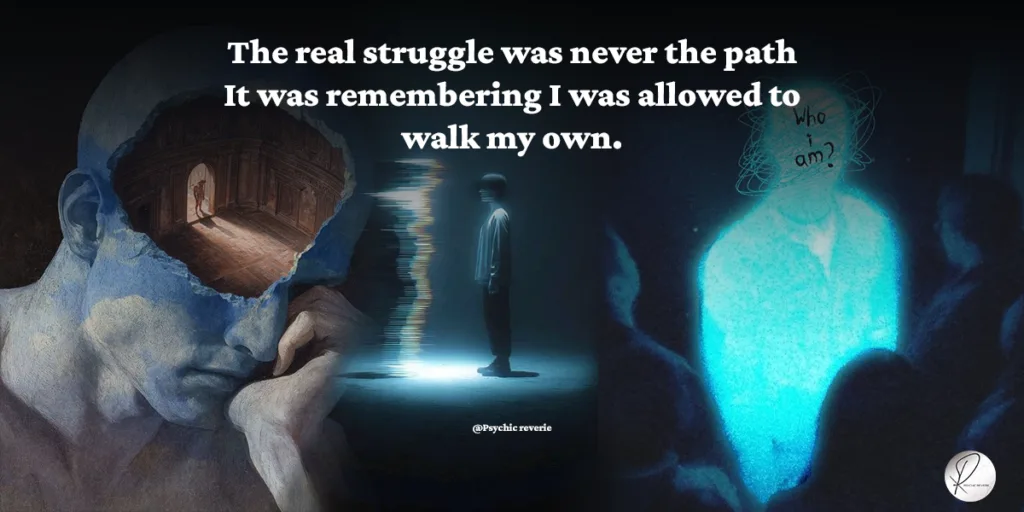
A line from the show K-Pop Demon Hunters captures this feeling perfectly:
"I lived two lives. Tried to play both sides, but I couldn't find my own place."
It sounds like a dramatic movie quote, but for many of us, it’s just daily reality. Young people are constantly balancing expectations, ambitions, responsibilities, and personal dreams. In that process, it's incredibly easy to lose sight of who you actually are.
But here is the good news: Feeling lost doesn't mean you're failing. Sometimes, it's the first sign that you're finally starting to discover your true purpose.
The Two Versions of You (And the Space in Between)
From childhood, we're taught exactly how to become successful:
Parents teach us based on protection and their own life experiences.
Society teaches us based on comparison, metrics, and rigid standards.
Neither side is necessarily wrong. The problem starts when their voices become so loud that we completely stop hearing our own.
In the middle stands another version of you, the one that dreams differently, wants genuine meaning over blind approval, and wonders:
"What do I actually want from my life?"
For most students, this internal conflict hits hardest during major crossroads: choosing a degree or major, selecting a long-term career path, or trying to manage daily study goals alongside family expectations.
This is where you begin to feel stuck. Not because you are weak, but because you're trying to satisfy everyone at the exact same time.
Why So Many Young People Feel Lost Today
Today's generation has more opportunities than ever before, but it also comes with unprecedented pressure. Every single day, your brain deals with a non-stop loop of:
- Social media comparison (watching everyone else's highlight reels)
- Academic pressure and grading stress
- Career confusion in a rapidly shifting economy
- Family expectations to maintain a specific status
Everyone seems to have an opinion about what you should become. Very few people stop to ask what you want to become. So naturally, students start living for approval instead of direction. That’s where the real confusion begins. You can stay busy every single day and still feel completely disconnected from your purpose.
The 80/20 Rule for Personal Alignment
You do not have to drop out of school or disappoint your family tomorrow to find yourself. Real life requires practical balance. Instead of making a reckless change, use the 80/20 Alignment Strategy:
The 80% Track (Stability):
Dedicate 80% of your energy to your current responsibilities, passing your exams, attending lectures, and fulfilling family obligations. Treat this track like a temporary job that funds your ultimate freedom. Keep your safety net intact.
The 20% Track (Growth):
Strictly lock down 20% of your week, just 3 to 5 hours, entirely for you. Use this uninterrupted time to learn a digital skill, work on a passion project, or research the career track you actually want to build.
By separating your time this way, you remove the terrifying pressure of having to choose between your dreams and your reality. You can honor both.
How Can Doing Nothing Lead to Success? Embracing the Art of “Doing Nothing”
The paradox of doing nothing is not new. Ancient Taoist philosophy introduced the principle of Wu Wei, often translated as “non-action” or “effortless action.” Wu Wei is not about passivity or apathy, It is about harmony. It teaches that .....
How to Balance Study and Practical Life
One common mistake is believing that academic success alone guarantees a happy life. Getting the grades is important, but true success requires developing practical life skills alongside your studies.
The most successful young adults focus heavily on two distinct tracks:
| Track 1: Academic Growth | Track 2: Practical Life Skills |
|---|---|
| Building consistent, focused study habits | Learning real-world problem-solving |
| Mastering time management | Developing emotional intelligence |
| Understanding core concepts (not just memorizing) | Building professional networks & relationships |
| Improving written communication | Learning financial responsibility & budgeting |
The 7 Practical Solutions to Find Your Own Path
These are not abstract theories, these are simple, tactical mental tools you can actually use starting today to bridge the gap between your studies and practical life.
1. The 10-Minute Clarity Reset (Daily Practice)
Instead of overthinking your entire life, spend just 10 minutes at the end of the day writing down three things:
- What drained me today?
- What gave me energy today?
- What do I actually want more of?
Why it works: This builds self-awareness without pressure. You start understanding yourself based on real data instead of guessing.
Read more



2. The “One Direction Rule” for Students
Stop trying to fix everything at once. Pick ONE main area of focus for the next month:
Study improvement OR skill-building OR career exploration.
Why it works: Focus creates speed. Confusion kills progress. Picking one track reduces stress and gives you total control over your momentum.
3. The 3-Question Decision Filter
Before committing to any big choice (like a major, a career track, or a lifestyle shift), run it through this quick checklist:
- Will this choice genuinely improve my position in 6 months?
- Will this decision sustainably reduce my long-term stress?
- Will I grow inside this path rather than feeling trapped?
Why it works: If most of your answers land in the "no" column, pause the decision. It protects you from making choices based entirely on external pressure.
4. The 70% Clarity Rule
Most students stay stuck because they are waiting until they are 100% sure about their future. Don’t wait. If you are 70% sure about a path, step onto it and start moving.
Why it works: True clarity comes after action, never before it. Action gives you data; overthinking just gives you anxiety.
5. The “Silent Hour” Technique
Once a week, lock down exactly 1 hour completely free from your phone, social media, and notification noise. Sit with a notebook and ask yourself two raw questions:
What am I becoming?
Do I actually like this direction?
Why it works: It forces you to reconnect with your own voice after a week of listening to everyone else's opinions.
6. Replace Comparison with Tracking
Looking at other people's success feeds insecurity. Shift your focus inward and track your own weekly metrics instead:
- What minor thing did I improve this week?
- What practical skill did I build or test?
- What did I learn from a mistake this week?
Why it works: When you compare yourself only with your past self, your self-confidence begins to grow naturally.
7. Build a “Practical Life Skill” Alongside Study
Do not depend entirely on your grades. Academic knowledge gets you through exams, but real-world independence requires functional skills.
Digital Skills: Content creation, freelance writing, graphic design, or SEO.
Human Skills: Advanced communication, problem-solving, or basic personal finance.
Why it works: Study builds your knowledge base. Practical skills build your personal freedom.
Quick Win: The 2-Minute Action Blueprint
Open the notes app on your phone right now. Complete these three sentences without filtering your answers:
- The life I am expected to live is __________.
- The life I secretly want is __________.
- One small step I can take this week to bridge the gap is __________.
Now, apply the Micro-Habit Rule:
Look at your answer for step number three. To ensure you actually follow through, shrink it, schedule it, and protect it.
If your step was "learn video editing," shrink it to "watch one 10-minute tutorial on YouTube today."
Schedule an exact time for it in your phone calendar (e.g., Tuesday at 6:00 PM), and protect it by putting your phone on Do Not Disturb for just those 15 minutes.
Understanding Yourself Is Not Rebellion
Many students stay on the wrong track because they are terrified of disappointing the people who love them. But taking the time to understand your own needs doesn’t mean rejecting your family, cutting off your responsibilities, or abandoning society.
The goal is not rebellion, the goal is alignment.
When your study habits, personal goals, and life choices match your true inner values, everything becomes clearer. The real journey of young adulthood isn't about choosing between your dreams and your realities. It's about learning how to honor both.
Your life should not be defined only by expectations. It should be defined by the person you are actively becoming. Stop choosing sides, and start choosing yourself.
Clarity doesn’t come from thinking more. It comes from learning how to think better.


